


Scenic & Entertainment Rail Tours Across Europe for UK Travelers
There is a kind of holiday that the European rail network does better than almost anywhere else: the slow, multi-city trip where the journey is part of the point. For British travellers, Eurostar from St Pancras plus the wider Interrail network turns a long weekend into a continent-hopping food and entertainment tour — no airport queues required. This guide covers three of the most rewarding routes from London — Paris, Amsterdam, and Berlin — focused on what is worth eating, where to spend an evening, and how to plan it well.

Why rail still wins for short European breaks
Compared with flying, taking the train into Europe means city-centre to city-centre travel, a generous luggage allowance, and the freedom to keep a glass of something in front of you for most of the journey. For trips of two to four nights — the most common British holiday length — the door-to-door time often beats flying once airport transfers, security queues, and the inevitable padding before the gate are factored in.
There is also a quieter benefit that is harder to quantify: a train trip feels like a holiday from the first minute. You sit down with a coffee, the landscape changes outside the window, and there is none of the low-grade stress that airports generate by design. By the time you arrive in Paris, you have already eaten lunch, read a chapter of your book, and watched the Kent countryside give way to the Pas-de-Calais.
A few essentials before booking:
- Passports: Post-Brexit, UK passports must have at least three months’ validity remaining beyond your planned departure date from the Schengen Area, and must have been issued within the last ten years from the date of entry. A small but increasingly common rejection at borders.
- Eurostar: Direct trains run from London St Pancras to Paris, Brussels, Amsterdam, Rotterdam, and (seasonally) destinations such as the French Alps and the south of France. Booking three to eight weeks ahead generally gives the best fares; last-minute walk-up tickets can be eye-watering.
- Interrail Pass: Available to UK residents and covers train travel across more than thirty European countries. A flexible “select” or “global” pass works particularly well for multi-city trips, and the mobile pass on the Rail Planner app is now the standard format.
- Seat reservations: High-speed services (Eurostar, Eurostar Red — the former Thalys — ICE, TGV, Frecciarossa) require a seat reservation on top of an Interrail pass, so book those segments in advance. Regional and slower trains usually do not.
- Premier vs Standard class: Premier on Eurostar includes a hot meal and lounge access at St Pancras and is often cheaper than a comparable flight in business. Standard is perfectly comfortable for the journey times involved.
- Bring a paper backup. Apps are excellent until your phone runs out of battery on a packed regional train. A printed copy of key reservations is good travel hygiene.
Route 1: London → Paris (around 2h 20m by Eurostar)
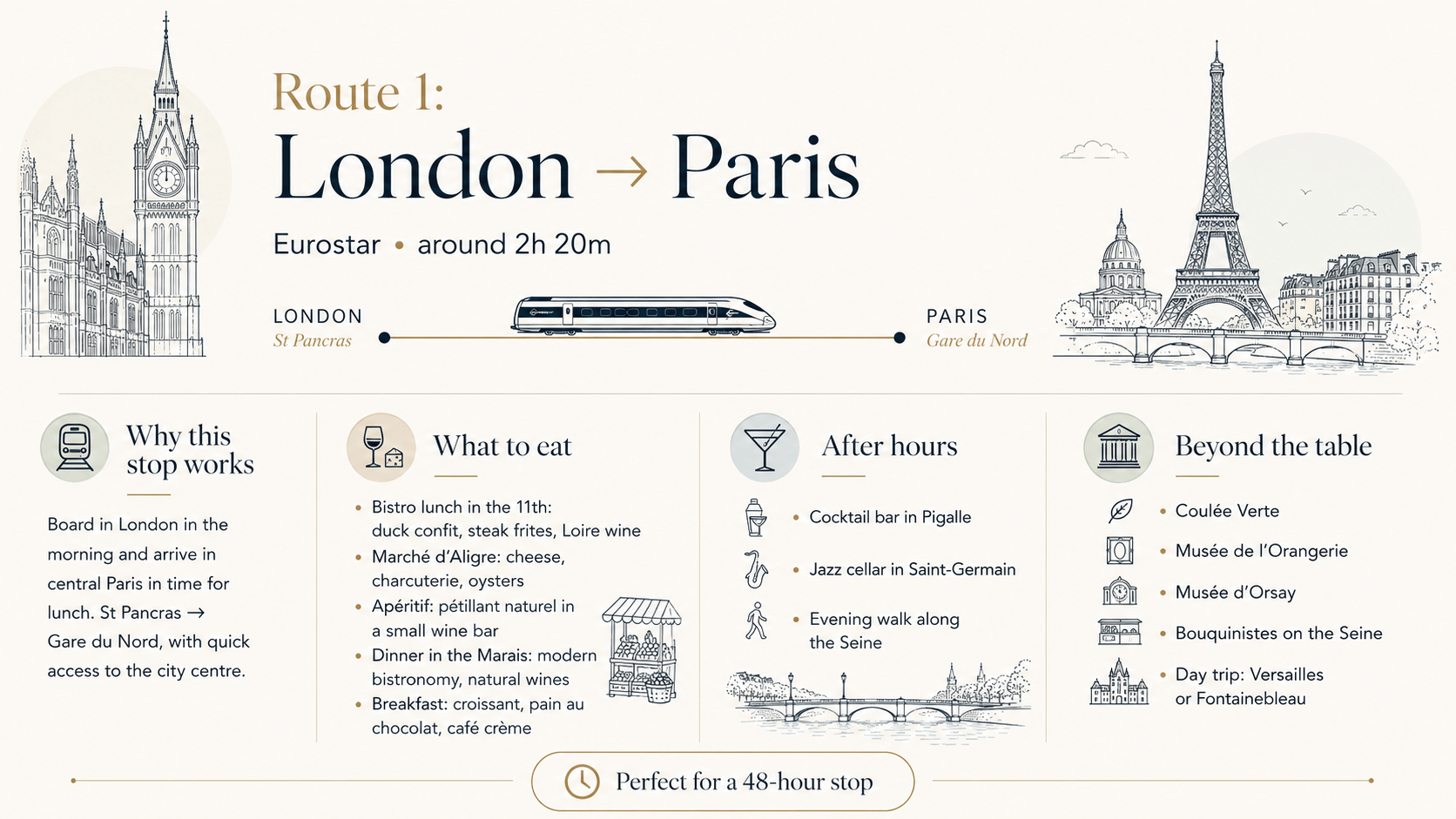
Paris is the natural first step. The Eurostar from St Pancras drops you at Gare du Nord, a fifteen-minute walk or a short Métro ride from most of the central arrondissements. The proximity is the point: you can board in London at 9 a.m. and be sitting down to lunch in the 10th by 1 p.m. local time.
What to eat. Skip the obvious tourist traps near the Champs-Élysées and head instead for the bistros of the 11th arrondissement and the wine bars of the Marais. A working itinerary for a 48-hour stop:
- Lunch in the 11th: Classic bistro cooking — duck confit, steak frites, a carafe of something from the Loire. The streets around Rue Paul Bert are particularly rewarding.
- Afternoon market: Marché d’Aligre for cheese, charcuterie, and oysters by the dozen, with a covered hall for when the weather turns.
- Apéritif: A glass of pétillant naturel at a small wine bar around 6 p.m. — a French habit that resets the day.
- Dinner in the Marais: Modern bistronomy — short menus, natural wines, no rush. Book ahead; the best rooms have fewer than twenty covers.
- Late evening: A cocktail bar in Pigalle, a jazz cellar in Saint-Germain, or simply a walk along the Seine with an ice cream from Berthillon.
- Breakfast the next morning: A proper boulangerie — croissant, pain au chocolat, café crème — eaten standing at the counter like a local.
Beyond the table. If the weather is kind, the Coulée Verte (Paris’s elevated park, the inspiration for New York’s High Line) is a genuinely lovely walk. The Musée de l’Orangerie is small enough for a focused visit before lunch and houses the Monet Water Lilies cycle. The Musée d’Orsay rewards a half-day. And the bouquinistes along the Seine still sell second-hand books and old prints worth bringing home as souvenirs that are not key rings.
For an unhurried second day, consider a day trip on the regional RER to Versailles or Fontainebleau — both achievable as a morning out with time to spare for an evening in central Paris.
Route 2: London → Amsterdam (around 3h 55m by Eurostar)
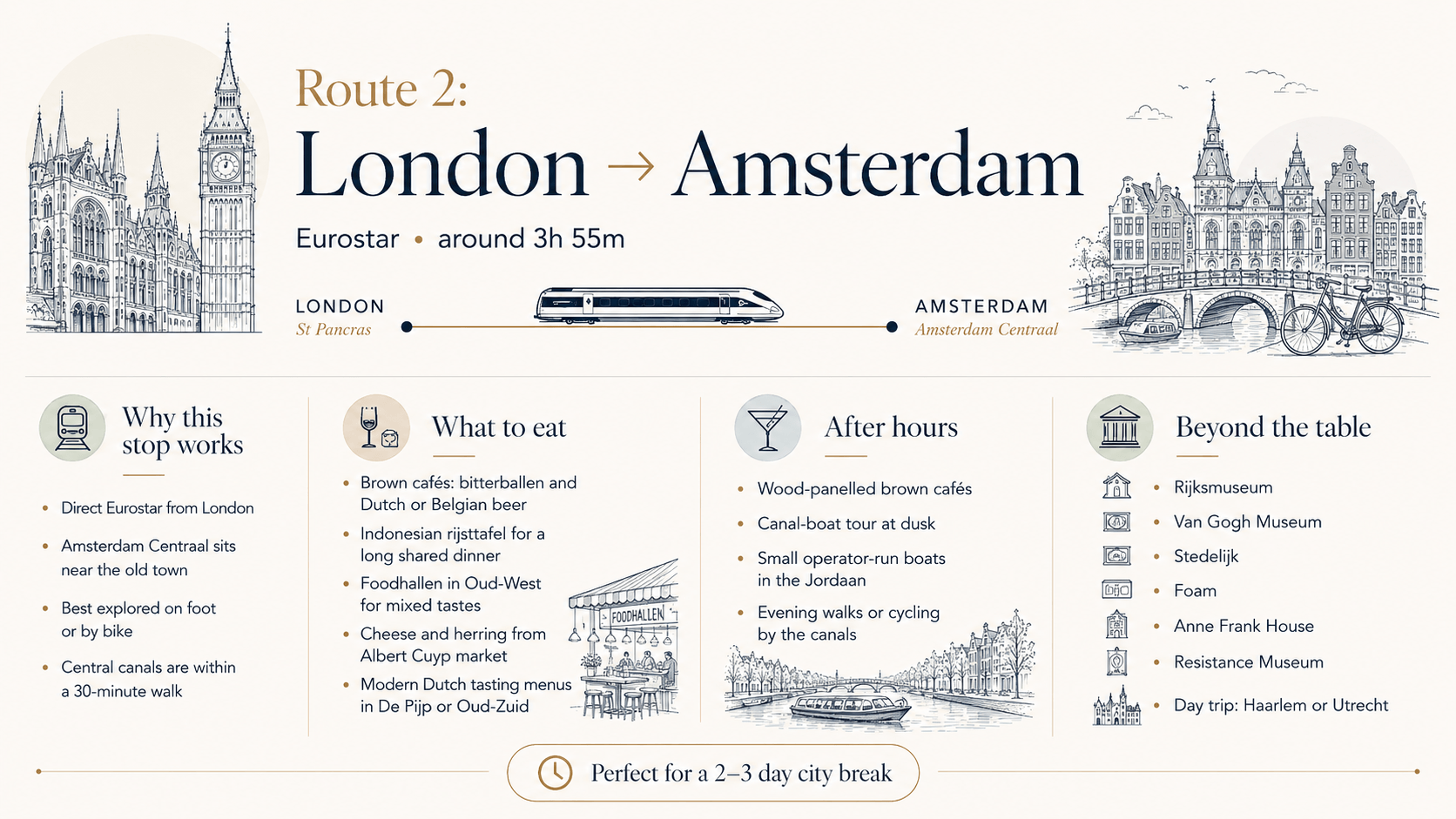
Direct Eurostar trains run from London St Pancras to Amsterdam Centraal, with the station sitting almost in the middle of the old town. Amsterdam rewards visitors who walk and cycle rather than try to navigate by tram — and the city is small enough that almost everything worth seeing is within a thirty-minute walk of the central canals.
What to eat. Dutch food is having a moment — confident, ingredient-led, and unpretentious. The clichés about boiled vegetables are out of date by about three decades.
- Brown cafés for bitterballen and a small Belgian or Dutch beer before dinner. The wood-panelled interiors are a destination in themselves.
- Indonesian rijsttafel — a legacy of Dutch colonial history and one of the city’s signature dining experiences. A dozen or more small dishes shared between two; ideal for a long evening.
- The Foodhallen in Oud-West for a mixed group meal where everyone gets what they actually want — Vietnamese, Spanish, Dutch, and Middle Eastern stalls under one roof.
- Cheese and herring from a proper market stall rather than a souvenir shop. The Albert Cuyp market is touristy but the produce is the real thing.
- Modern Dutch tasting menus in Oud-Zuid or De Pijp — confident, seasonal cooking that does not get the international attention it deserves.
Beyond the table. The Rijksmuseum and Van Gogh Museum are obvious, but the smaller institutions reward a visit too — the Stedelijk for modern art, the Foam for photography, and the Anne Frank House and Resistance Museum for a sobering counterweight. A canal-boat tour at dusk is touristy, but it is also genuinely beautiful, and the small operator-run boats out of the Jordaan are a long way from the tour-bus experience.
If you have a third day, the train to Haarlem (15 minutes) or Utrecht (25 minutes) shows you a quieter, more local Netherlands without losing any travel time worth speaking of.
Route 3: London → Berlin (around 8–10 hours with one change)
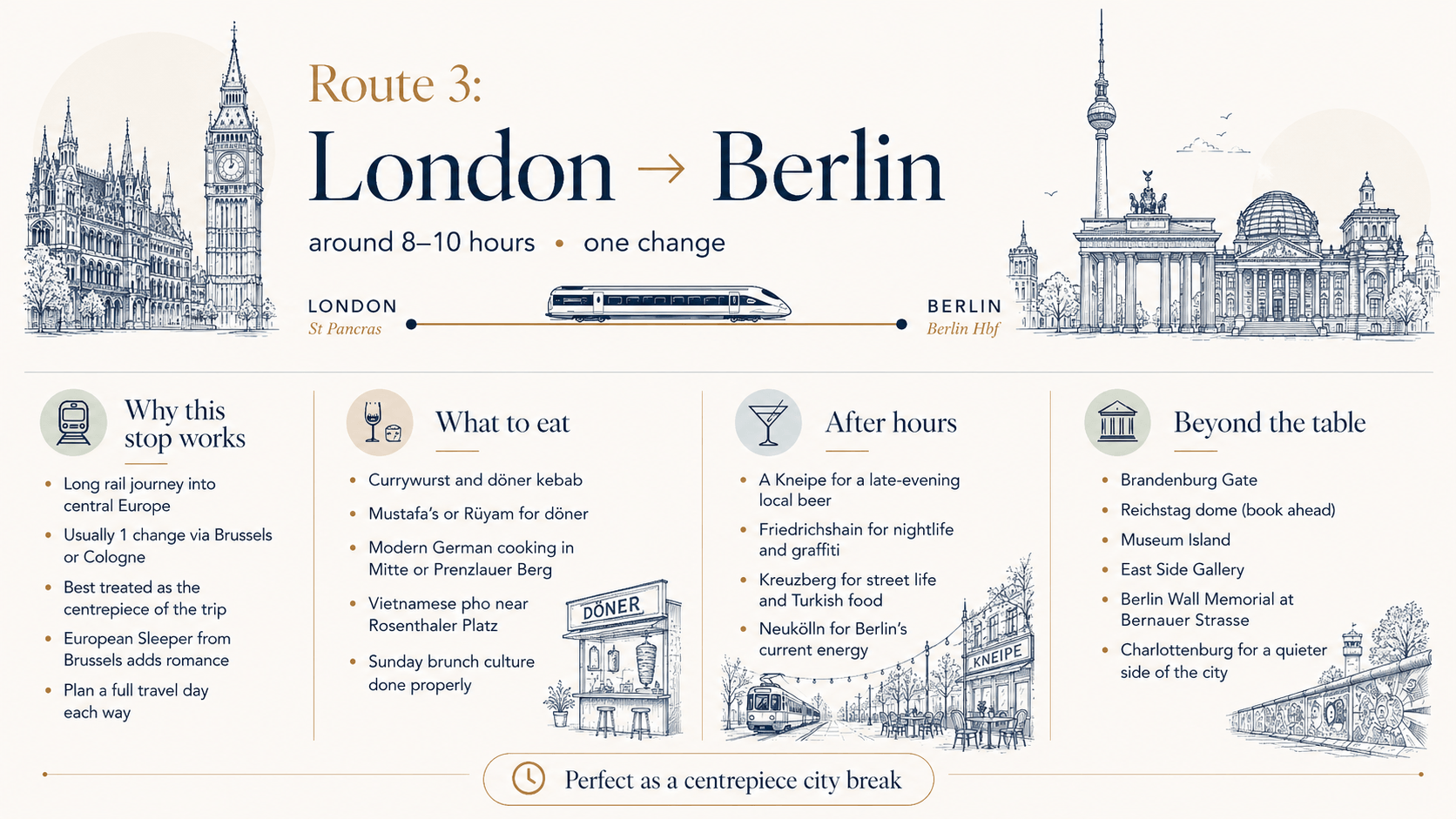
Berlin is the longest of the three routes from London, typically requiring a change at Brussels or Cologne, sometimes with a further connection in Hannover. The journey is part of the appeal — a slow descent into the heart of central Europe with the landscape changing visibly outside the window. Plan a full travel day each way and treat Berlin as the centrepiece of the trip rather than a side stop.
A new direct sleeper service between Brussels and Berlin, operated under the European Sleeper banner, has made the route more appealing again — leaving in the evening and arriving in time for breakfast is the most romantic way to enter Germany.
What to eat. Berlin’s food scene is messy, multicultural, and excellent value compared with London. The city has spent the last twenty years quietly becoming one of the most interesting places to eat in Europe.
- Currywurst and döner kebab are the city’s two great street-food traditions and both deserve at least one outing. Mustafa’s near Mehringdamm is the famous döner queue; the döner at Rüyam in Schöneberg is just as good with half the wait.
- Modern German cooking in Mitte or Prenzlauer Berg — think seasonal vegetables, fermented everything, and Riesling by the glass.
- Vietnamese pho in the streets around Rosenthaler Platz, a legacy of East Berlin’s Vietnamese community.
- Sunday brunch culture — Berliners take it seriously, and so should you. Expect long tables, slow service, and the rest of the day written off.
- A Kneipe for the late evening — the local equivalent of a corner pub, ideally without a menu in English.
Beyond the table. The standard sights — Brandenburg Gate, the Reichstag dome (book free tickets in advance), Museum Island, the East Side Gallery, Checkpoint Charlie — earn their reputation, but Berlin is at its best when you let neighbourhoods rather than checklists guide you. Kreuzberg for street life and Turkish food, Friedrichshain for nightlife and graffiti, Charlottenburg for an older, quieter version of the city, and Neukölln for the version Berliners themselves now spend their time in.
The Berlin Wall Memorial at Bernauer Strasse is the single most informative twenty minutes you can spend on the city’s recent history — far more so than the busier Checkpoint Charlie tourist trap.
Evening Leisure: Visiting the Best Land-Based and Legal European Gaming Clubs During Express Stopovers
For British travellers who enjoy the casino as a part of an evening out — the way one might book a theatre ticket or a tasting menu — Europe’s land-based gaming clubs are a genuinely interesting cultural stop. They are licensed by national regulators, they enforce strict ID and dress standards, and they are usually housed in buildings that are worth seeing in their own right. Many of the continent’s grandest casinos are nineteenth-century rooms with chandeliers and parquet floors, a long way from the carpeted barns familiar from some other parts of the world.
A short guide for the three cities above:
- Paris — French casinos historically operate just outside the city limits, a quirk of nineteenth-century legislation that has never been undone. Enghien-les-Bains, a 20-minute train ride from Gare du Nord, is the closest to central Paris and the largest casino in France. Expect formal dress codes, a passport check on entry, and a strong tradition of boule, blackjack, and roulette alongside the electronic gaming floor. The town itself, built around a thermal lake, is worth a half-day even if you do not play.
- Amsterdam — Holland Casino operates a flagship venue near Leidseplein, in the centre of the city’s main nightlife district. It is well-regulated under Dutch law, accepts walk-ins (with photo ID), and is integrated into the city’s broader evening economy — restaurants, theatres, and bars are all within a five-minute walk. Smart casual dress is generally enough; trainers are usually fine.
- Berlin — Spielbank Berlin at Potsdamer Platz is the central option. It is large, modern, and combines a “classic” gaming room (with a slightly stricter dress code) with a separate slots floor that is more relaxed. ID is required, dress is “tidy”, and the venue stays open very late.
A few practical points worth knowing as a British visitor. Each of these venues is regulated by the national authority of its country, not by the UK Gambling Commission — so the rules on stake limits, identification, self-exclusion, and dispute resolution differ from what you may be used to at home. Bring your passport (a driving licence usually is not enough for entry to a continental European casino), expect a small entry fee at some venues, and set a strict cash budget before you sit down. Treat the cost of an evening the way you would the cost of dinner and a show, not as an investment.
A note on language: dealers and floor staff at all three of the venues above speak working English, but a polite bonsoir / goedenavond / guten Abend goes a long way and is invariably appreciated.
Many British travellers also use the planning stage to compare online options — particularly the platforms that operate outside the UK’s national self-exclusion framework and that remain legally accessible to UK residents. If that is part of your research, our main guide to the best non-GamStop casinos for UK players goes through the licensing, payments, and player-protection considerations in detail.
Whether you spend the evening at a real-money table or simply admire the building from the bar, the European casino tradition is a part of the continent’s leisure landscape worth understanding — and a low-effort, high-character addition to a rail-based itinerary.
A sample 7-day itinerary
A realistic week combining all three cities, leaving from London on a Friday morning and returning the following Thursday evening:
| Day | Route | Approx. journey | Focus |
|---|---|---|---|
| Friday | London → Paris | 2h 20m | Arrival, dinner in the Marais |
| Saturday | Paris | — | Markets, museums, evening out |
| Sunday | Paris → Amsterdam | 3h 20m (via Eurostar) | Late lunch, canal walk |
| Monday | Amsterdam | — | Museums, rijsttafel dinner |
| Tuesday | Amsterdam → Berlin | 6h 30m (via ICE, change at Hannover) | Travel day, late arrival |
| Wednesday | Berlin | — | Mitte by day, Kreuzberg by night |
| Thursday | Berlin → London | 9h 45m (via Brussels) | Long travel day home |
Built around an Interrail Global Pass with the Eurostar segments booked separately, the total transport cost typically lands well below the equivalent in flights and city-centre transfers — and the trip starts the moment you sit down at St Pancras, not when you finally clear airport security.
For travellers with more time, two natural extensions are worth considering. Adding Brussels as a half-day stop between Paris and Amsterdam costs almost nothing in travel time and rewards you with one of Europe’s most underrated food cities. Adding Prague after Berlin (about 4h 30m by direct train) extends the trip into central Europe and shifts the price level pleasantly downward.
Practical tips for British travellers
A short list of things that consistently make the difference between a smooth trip and a stressful one.
| Topic | What to know |
|---|---|
| Travel insurance | A GHIC covers state medical care in the EU but is not a substitute for full travel insurance — pick a policy covering rail delays and missed connections. |
| Cash and cards | Most places take contactless, but keep €50–100 in cash for taxis, tips, and cash-only cafés. |
| Mobile data | Roaming charges returned for many UK customers after Brexit. Check your provider’s EU policy or buy a local eSIM. |
| Booking apps | Eurostar, SNCF Connect (FR), NS International (NL), DB Navigator (DE) cover almost every leg. |
| Power and adapters | Continental Europe uses a different plug. Pack one good multi-adapter rather than three cheap ones. |
| Luggage | Stations have lifts and escalators, but you carry your own bag up the hotel steps. A 40–55 litre case is plenty for a week. |
| Tipping | 5–10% in restaurants where service is not included; round up taxis. Far less expected than in the UK or the US. |
A final piece of advice that does not fit neatly in a table: leave space in the itinerary. The best moments of a rail trip — the side-street bistro, the bookshop you wandered into, the conversation at the bar of the dining car — are the ones you did not plan for. The route gets you there. What happens once you arrive is the holiday.
The right rail trip turns three cities into one continuous holiday. Choose the food first, build the route around it, and leave space for the evenings to surprise you — which, on the European network, they reliably do.
Resent news