




Differences in the Regulation of Tourism and the Entertainment Industry: UK vs EU
For decades, a British traveller could assume the rules on the other side of the Channel broadly matched those at home — consumer rights, roaming, healthcare cover, and leisure regulation all moved in roughly the same direction. Brexit changed that. The UK and the EU now run two systems on different timetables, with different priorities, and occasionally opposite directions. This article walks through the main areas where the two now diverge, focused on what actually matters for a British traveller in 2026.

Travel documents, borders, and the 90/180 rule
The first and most obvious change is at the border. UK passport holders are now treated as third-country nationals when entering the Schengen Area. In practice that means:
- A separate (usually longer) queue at passport control, with passports stamped on entry and exit.
- A passport that must have been issued within the last ten years on the date of entry, and that has at least three months’ validity remaining beyond the planned date of departure from the Schengen Area.
- A limit on time spent in the Schengen Area: 90 days within any rolling 180-day period, across all Schengen countries combined. Stays in Ireland and Cyprus do not count toward this total.
From 2026, two new EU systems are gradually rolling out that British travellers need to be aware of:
| System | What it does | What it means for UK travellers |
|---|---|---|
| EES (Entry/Exit System) | Replaces passport stamps with a biometric record of entries and exits | Fingerprints and a facial scan on first entry; faster e-gate use afterwards |
| ETIAS | A pre-travel authorisation (not a visa) for visa-exempt visitors | Online application before travel, small fee, valid for three years |
Neither system makes travel impossible or particularly difficult, but both add steps that did not exist before 2020. The practical advice is to check the current status of both systems a week or two before any trip, allow more time at the border than you would have done historically, and keep an eye on your 90/180 allowance if you travel frequently.
Driving, healthcare, and mobile data
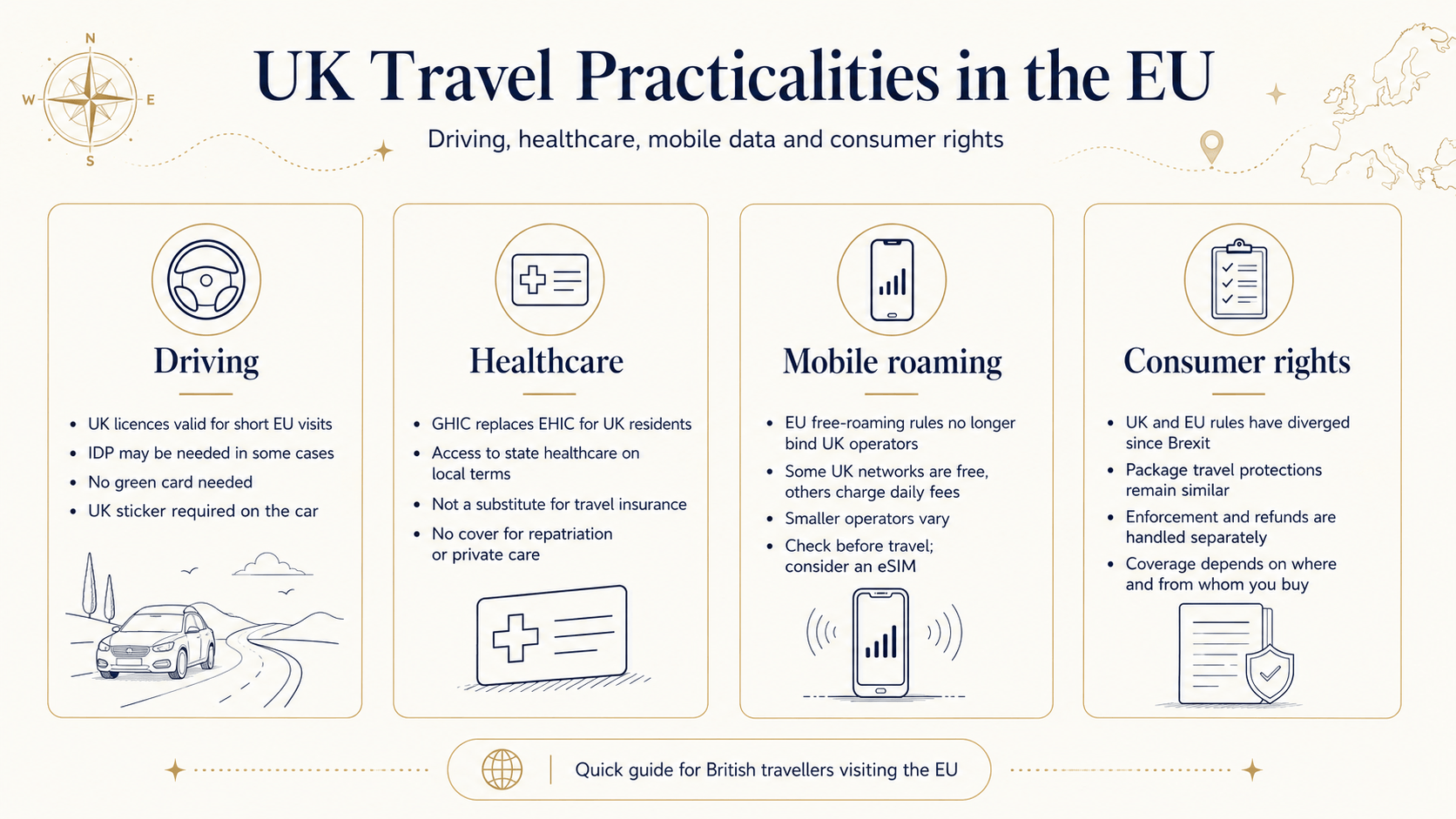
A cluster of smaller changes adds up to a meaningfully different travel experience.
Driving. UK driving licences remain valid for short visits across the EU, but an International Driving Permit may be needed in some specific cases (older paper licences, certain non-EU countries). Insurance “green cards” are no longer required for UK-registered cars driving into the EU — but a UK sticker on the rear of the vehicle is.
Healthcare. The Global Health Insurance Card (GHIC) replaced the EHIC for UK residents and still gives access to state-provided medical care in EU countries on the same terms as locals. The crucial point that catches people out: it is not a substitute for travel insurance. Repatriation, private treatment, and any care outside the state system are not covered.
Mobile roaming. The EU rule that abolished roaming charges within the bloc does not bind UK operators. Most large UK networks have either kept fee-free EU roaming or introduced a small daily charge; smaller operators vary. Check before you travel, and consider an eSIM for longer trips.
Consumer rights. UK and EU consumer protection law diverged on day one of Brexit and has been drifting further apart since. The EU’s Package Travel Directive and the UK’s Package Travel Regulations are still closely related, but enforcement, dispute resolution, and refund rights are now handled separately. A British traveller buying a package holiday from a UK operator is covered by UK law; the same package bought from a Dutch operator while in Amsterdam is covered by Dutch and EU law.
Tourism: a regulatory snapshot
The broad regulatory environment for tourism — passenger rights, accommodation standards, data protection — has not changed beyond recognition, but the channels for enforcing those rights have. A British traveller now relies on UK regulators for protection against UK companies, and on the consumer-protection bodies of the country they are visiting for protection against European companies.
The most relevant differences for a typical holiday:
| Area | UK position | EU position |
|---|---|---|
| Passenger rights (delays, cancellations) | Retained EU261 (UK261), broadly equivalent | EU261 (Regulation 261/2004) |
| Package travel protection | UK Package Travel Regulations | EU Package Travel Directive |
| Data protection | UK GDPR | EU GDPR |
| Short-term lettings (e.g. Airbnb) | Local authority rules in the UK | Increasingly tight national / city rules across the EU |
| ATM and card fees | UK rules apply to UK-issued cards | EU rules apply to EU-issued cards; cross-border use sits between them |
For most travellers, the practical takeaway is straightforward: keep proof of purchase, keep contact details for the relevant regulator in the country where the trip was booked, and do not assume that a UK enforcement body can step in to resolve a dispute with a company operating purely in another jurisdiction.
Entertainment and leisure: where the UK and EU genuinely diverge
This is where the post-Brexit picture gets more interesting. The entertainment industry — and online gaming in particular — has always been regulated nationally rather than at EU level, even when the UK was a member state. Brexit therefore did not “create” the divergence so much as remove the shared framework that had partially smoothed it over.
Three points are worth understanding clearly.
- There is no single EU regulator for online gaming. Each member state licenses its own market. Malta, Sweden, Denmark, Spain, France, Germany, and the Netherlands all run their own regulators with their own rule sets. The closest thing to a pan-European “gold standard” licence is the Malta Gaming Authority (MGA), but an MGA licence is not the same thing as an EU-wide passport — it is a Maltese national licence that other countries may or may not accept for their own residents.
- The UK Gambling Commission (UKGC) is one of the strictest regulators in the world. Since Brexit, and particularly since the 2023 White Paper reforms, UK rules have moved toward stricter affordability checks, lower default stake limits on slot games, tighter restrictions on bonus marketing, and the integration of the national self-exclusion scheme GamStop across every UKGC-licensed operator. The UK approach reflects a particular philosophy: prevent harm by limiting access and engineering friction into the product itself.
- Other European licences regulate the same industry on a different philosophy. Maltese, Curaçao, Gibraltar, and Isle of Man licences all impose meaningful obligations on operators — anti-money-laundering checks, fair-play audits, dispute resolution, responsible-gambling tools — but they do not, for example, require integration with GamStop, do not impose UK-style affordability checks, and do not cap stakes in the same way. The result is a regulated industry that operates under genuine oversight, but with a different balance between consumer protection and consumer freedom.
A side-by-side comparison of the most visible differences:
| Feature | UKGC-licensed sites | MGA / Curaçao-licensed sites |
|---|---|---|
| National self-exclusion | GamStop integration mandatory | Not connected to GamStop |
| Affordability checks | Mandatory above thresholds | Operator discretion |
| Slot stake caps | £2 (under 25s) / £5 default | Higher, set by operator within licence rules |
| Bonus rules | Tightly restricted, no wagering on free spins common | More flexible, varied wagering models |
| Credit-card deposits | Prohibited (since 2020) | Generally permitted |
| Cryptocurrency | Prohibited | Widely supported |
| Dispute resolution | UKGC + IBAS | National regulator + ADR body |
The takeaway is not that one approach is right and the other wrong — that is a genuine policy debate on which reasonable people disagree. The takeaway is that they are different, and that the difference is significant enough for travellers and residents to know which framework they are dealing with.
Why European online platforms remain accessible to British travellers
A common assumption is that Brexit “cut off” UK residents from European online services. For some industries that has happened in narrow ways — financial services passporting, broadcasting rights, certain professional services. For online gaming, the picture is the opposite: most European-licensed platforms remain legally accessible to UK residents, and many actively serve the UK market.
The reasons are largely structural:
- Licensing is the operator’s responsibility, not the player’s. An MGA-licensed casino is operating under Maltese law. If that operator chooses to accept UK customers, it is doing so within its own regulatory framework. UK residents are not breaking any UK law by playing on a platform that does not hold a UKGC licence.
- The UK does not run a national blocklist of foreign gambling sites. Some EU countries (Italy, Spain, the Netherlands in some cases) do operate such blocklists for sites that have not obtained a local licence. The UK has consistently chosen not to.
- Payments remain functional. UK debit cards, Visa, Mastercard, and most major e-wallets continue to process transactions to European-licensed operators — subject to the issuing bank’s own policies.
- Responsible-gambling tools still exist, just in different forms. A player using a non-UKGC platform is not connected to GamStop, but the operator is still required by its own licence to provide deposit limits, time-outs, self-exclusion, and access to support resources. The tools are there; they simply sit at the operator level rather than at a national level.
For British travellers spending time in Europe — whether on a week-long rail trip, a longer stay with family, or a remote-working stint — this matters in practical terms. Familiar UK platforms continue to be accessible from abroad (subject to the operator’s own geographic policies). European-licensed platforms are accessible both at home and on the move. And the experience of using either is broadly the same wherever you happen to be sitting.
The trade-off to understand is the one already described above: a European-licensed platform offers more flexibility (higher limits, broader game selection, crypto support, more varied bonus structures) but a different model of player protection. Whether that suits you depends on how you prefer to manage your own play.
What this means in practice for British travellers
A short, honest summary for the British traveller trying to make sense of all of the above:
- For tourism. Plan a little earlier than you used to. Watch your 90/180 allowance. Buy proper travel insurance, not just a GHIC. Know which country’s consumer-protection regime applies to each part of your trip, and keep the paperwork.
- For everyday life abroad. Roaming, card use, and ATM withdrawals all still work — but each can carry small fees that did not exist pre-Brexit. Plan for them rather than discover them on the statement.
- For leisure and entertainment. Recognise that the UK and the EU now regulate the same industries differently, and that “different” does not mean “worse”. The British traveller who understands which licence sits behind which platform — UKGC, MGA, Gibraltar, Isle of Man, Curaçao — is in a much better position to choose what suits them.
- For online gaming specifically. UK residents have a genuine choice between UKGC-licensed sites (with the strictest player-protection framework in the world) and European-licensed sites (with more flexibility and a different protection model). Both are legal options. The right one depends on your own priorities.
The post-Brexit picture is not the catastrophe some predicted, nor the clean break others promised. It is a more granular relationship in which the UK and EU now run parallel systems that overlap in many places, diverge in others, and require travellers to be a little more deliberate than before. For a generation that grew up assuming the rules were the same on both sides of the Channel, that is the real adjustment — and, once made, it is not a particularly difficult one.
The continent has not gone anywhere. The rules around it have just become a little more interesting to read.
Resent news